
5 Things Google Analytics Can't Tell You About Attribution
GA4 is free but limited. Discover 5 critical attribution gaps in Google Analytics and what you need to fill them for accurate marketing measurement.
ONClix Team
Google Analytics 4 is a staple for business owners across the US, offering a free and accessible way to track website behavior. While there are easily 5 things Google Analytics can do to help you understand basic traffic patterns, it struggles to tell the whole story when it comes to revenue. We have found that relying solely on it for marketing attribution often leads to expensive blind spots.
These limitations do not make GA4 a bad tool. It serves a specific purpose for general traffic monitoring. But using it as your only source of truth for budget allocation is risky.
You might be basing financial decisions on incomplete data without realizing it. Dedicated marketing attribution software fills these gaps by tracking 100% of conversions across every channel. We have identified the five most critical gaps that every business owner needs to understand.
1. Data Sampling Distorts Your Numbers at Scale
GA4 uses a process called data sampling when your reports demand too much processing power. If you request data covering a long date range or complex dimensions, the platform analyzes a subset of your traffic and estimates the totals.
This works like a political poll. Pollsters survey 1,000 people to guess how 300 million will vote.
The resulting data often lacks the precision needed for financial planning. In our experience with client accounts, we see sampling kick in as soon as an exploration report hits 10 million events.
Why This Matters for Your Budget Statistical noise is dangerous when every conversion counts. A sampling rate of 10% to 20% means your report is an estimate, not a ledger.
- The Reality: A campaign that generated 50 sales might show up as 38 or 62 in a sampled report.
- The Risk: You might cut a winning ad or double down on a losing one based on a guess.
How to Spot It Look at the top of your GA4 interface. If you see a green checkmark next to the report title, your data is unsampled. A yellow shield icon indicates that sampling is active.
The Fix: Unsampled Data Processing
Business owners need certainty. We recommend using dedicated attribution platforms or data warehouses (like BigQuery) that process 100% of your data. This ensures every single conversion is counted exactly as it happened.
2. Cross-Device Journeys Are Largely Invisible
Americans are more connected than ever. A recent Deloitte “Connected Consumer” survey found that the average US household now possesses 21 connected devices. A potential customer might see your ad on a smartphone during breakfast, research on a work laptop at lunch, and finally buy on a tablet in the evening.
GA4 attempts to bridge these gaps using Google Signals and User-ID. These features have strict limitations.
Google Signals requires users to be signed into their Google accounts with ad personalization turned on. User-ID only functions if the visitor logs into your specific website.
The “New User” Illusion This fragmentation creates a false narrative in your reports.
- Mobile Visit: User clicks an ad (No conversion).
- Desktop Visit: Same user returns directly and buys (Conversion).
- GA4 Report: Shows two separate users. The mobile ad gets zero credit, and “Direct Traffic” takes all the glory.
Comparing Identity Resolution Methods
| Method | How It Works | The Limitation |
|---|---|---|
| GA4 (Google Signals) | Uses Google account data | Limited to signed-in users with specific settings active. |
| GA4 (User-ID) | Uses your own login system | Does not track anonymous visitors before they sign up. |
| Identity Graphs | Stitches data via device patterns | Requires third-party tools but captures 30-50% more journeys. |
What Fills the Gap Advanced identity resolution is the solution here. We utilize technologies that combine deterministic matching (emails) with probabilistic matching (device patterns) to view that fragmented path as a single customer journey.
3. Walled Garden Data Stays in the Walled Garden
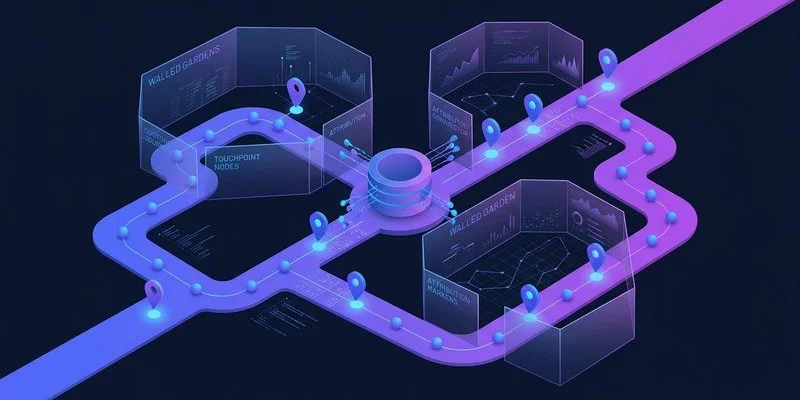
Major platforms like Facebook, TikTok, and LinkedIn operate as “walled gardens.” They hoard user data to maintain their competitive advantage. When a user views your ad on Instagram, GA4 has no way of knowing about that impression unless the user clicks.
This breaks the attribution chain. You might pay for three impressions that build a customer’s interest, but GA4 only sees the final click.
The Impact of Apple’s Link Tracking Protection
Recent updates have made this challenge even steeper. With the rollout of iOS 17 and later versions, Apple introduced Link Tracking Protection. This feature automatically strips tracking parameters like gclid (Google) and fbclid (Facebook) from URLs shared in Mail, Messages, and Safari Private Browsing.
Missing Funnel Data
- Impressions are lost: You cannot measure the “billboard effect” of ads people see but don’t click.
- Platform conversions are missing: If a user fills out a lead form directly on LinkedIn, that data never hits your website pixel.
The Fix: Server-Side Integration
We advise moving beyond simple pixel tracking. Implementing server-side API integrations (like Facebook CAPI or TikTok Events API) allows you to send conversion data securely back to the ad platforms. This helps “train” the ad algorithms to find better customers, even if GA4 misses the initial connection.
4. Offline Conversions Are a Blind Spot
The US Census Bureau reported in late 2025 that e-commerce accounts for roughly 16.4% of total retail sales. This means the vast majority of commerce—over 83%—still happens offline. For many local businesses and service providers, the website is just the handshake. The actual deal happens on the phone or in a store.
GA4 cannot natively see what happens after the browser closes. A customer might spend hours on your site and then walk into your showroom to buy.
The Disconnect Your digital marketing appears to be failing when it is actually succeeding.
- Scenario: You spend $1,000 on Google Ads.
- Result: You get 50 phone calls and 10 in-store sales.
- GA4 Report: Shows $1,000 spent and $0 revenue.
You can try to manually upload CSV files via the Measurement Protocol, but it is a tedious, technical process that is prone to error. If you cannot match the offline sale to a specific digital ID, the data is useless.
What Fills the Gap We integrate CRM systems directly with attribution tools. By connecting your point-of-sale or CRM (like Salesforce or HubSpot) to your tracking stack, you can automatically match a closed deal back to the Google Ad that started the conversation.
5. View-Through Conversions Are Not Tracked
Click-based attribution is outdated. Modern marketing relies on video and display ads to build brand awareness. If someone watches your YouTube video and visits your site three days later to buy, they were clearly influenced by the video.
GA4 will give 100% of the credit to “Direct Traffic” or “Organic Search.”
The Science of Influence Recent industry data indicates that viewable impressions can lead to a 95% increase in conversion rates compared to non-viewable ones.
- Programmatic Display: Often has a low click-through rate but a high influence rate.
- Connected TV (CTV): Almost entirely view-based (you can’t click a TV screen).
Ignoring these touchpoints means you will likely undervalue your top-of-funnel marketing. You might cut the budget for the very ads that are fueling your brand awareness.
The Fix: Impression Tracking
To solve this, we use platforms that support view-through attribution windows. These tools place a pixel that records ad impressions. When that same user converts later, the system can assign partial credit to the ad they saw, proving that your branding budget is working.
What This Means for Your Marketing Stack
Google Analytics 4 is a necessary tool for monitoring website health. We use it daily to check bounce rates and real-time traffic. However, relying on it for high-stakes financial decisions is like driving a car with a foggy windshield.
These gaps hit specific businesses harder than others.
- High-Ticket Items: Longer decision cycles mean more chances for data to break.
- Multi-Channel Strategy: If you run ads on Facebook and Google, you need a tool that sees both impartially.
- Hybrid Sales: If you sell online and offline, you need a bridge between those worlds.

A dedicated attribution platform like ONClix works alongside GA4 to provide clarity. It handles the heavy lifting that free tools cannot: unsampled data, true cross-device tracking, and offline integration. Our multi-touch attribution approach ensures every channel gets the credit it deserves.
The cost of bad data is real cash. We see it constantly in misallocated budgets and wasted ad spend. Accurate attribution is not just a metric; it is the foundation of profitable growth.