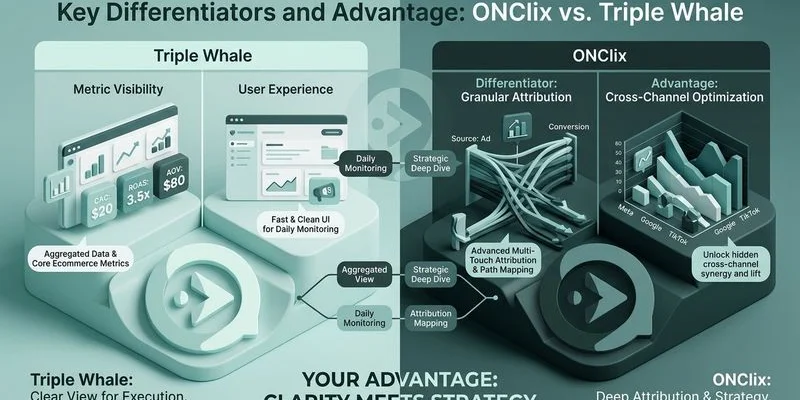
ONClix vs Triple Whale: Which Attribution Tool Is Right for You?
Triple Whale focuses on Shopify DTC. ONClix works across e-commerce and lead gen. Compare features, pricing, and platform support side by side.
ONClix Team
Two Different Approaches to Marketing Attribution
We know the feeling: you’re staring at your ad manager, and the numbers just don’t add up. Since the iOS14+ privacy updates, “signal loss” has become the industry’s biggest headache, turning what used to be clear data into a guessing game.
Triple Whale and ONClix both solve this by helping performance marketers see exactly which ads are actually driving revenue. But they were built for different audiences with completely different philosophies.
Triple Whale is a Shopify-first analytics and attribution platform designed specifically for direct-to-consumer (DTC) e-commerce brands. ONClix is a cross-platform attribution tool built for e-commerce, lead generation, SaaS, and multi-channel advertisers.
If you are evaluating both platforms, the right choice depends on your business model, your tech stack, and what you need beyond basic attribution. From our experience working with diverse ad accounts, the “best” marketing attribution software isn’t about features — it’s about fit.
This comparison covers every major dimension to help you decide.
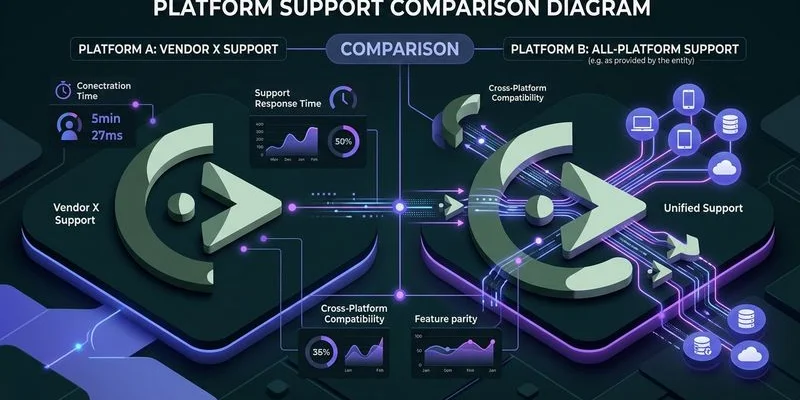
Platform Support
Triple Whale is unapologetically built around Shopify. The entire platform is designed as a Shopify app, and its deepest integrations—including the famous “Triple Pixel”—flow directly through the Shopify ecosystem. While they have expanded over the years, their core strength remains practically tethered to Shopify’s API.
If you run a WooCommerce store, a custom-built e-commerce site, or a lead generation business on WordPress or ClickFunnels, Triple Whale is likely not designed for your use case. Its value proposition relies on that specific data layer.
ONClix takes a platform-agnostic approach. It works with Shopify, WooCommerce, Magento, ClickFunnels, WordPress, Webflow, custom-built websites, and lead generation funnels. The tracking is implemented through a universal JavaScript snippet and server-side integration that functions regardless of your e-commerce platform or CMS.
Verdict: If you are exclusively on Shopify and plan to stay there forever, Triple Whale’s native integration is a massive strength. If you run on any other platform, or if you have a hybrid business (like e-commerce plus a lead-gen funnel), ONClix is the more versatile choice.
Attribution Models and Methodology
Triple Whale relies on its proprietary “Triple Attribution” model alongside standard first-touch, last-touch, and linear models. This proprietary model combines pixel data, Shopify order data, and—crucially—post-purchase survey data.
The post-purchase survey feature (“How did you hear about us?”) is a major differentiator. It captures “zero-party data” directly from customers, which helps fill in the gaps for hard-to-track channels like podcasts, TikTok influencer posts, or word-of-mouth.
ONClix supports a wider array of technical models: first-touch, last-touch, linear, time-decay, position-based, and data-driven attribution. Its attribution engine is built on server-side click tracking and conversion events, using persistent customer identity resolution to track users across devices.
While ONClix does not include a built-in post-purchase survey tool, its strength lies in its flexibility. You can toggle between models to see how a campaign performs at the top of the funnel (First Touch) versus the bottom (Last Touch).
Verdict: Triple Whale’s survey integration is genuinely useful for capturing “dark social” traffic that technical attribution often misses. ONClix offers more traditional algorithmic variety. If you rely heavily on influencer marketing and want self-reported data, Triple Whale has an edge. If you want rigorous technical flexibility across multiple algorithmic models, ONClix provides more options.
Ad Channel Support
Triple Whale supports the major players: Meta, Google, TikTok, Snapchat, Pinterest, and a growing list of ad platforms. They also offer CAPI (Conversion API) support for Meta and Google, which helps send server-side data back to the ad platforms to improve their optimization.
ONClix supports: Meta, Google, TikTok, Snapchat, and Pinterest. Support for Microsoft Ads, LinkedIn, and Twitter/X is coming soon. Like Triple Whale, it offers CAPI support for Meta, Google, and TikTok with automatic deduplication.
Channel Support Comparison
| Feature | Triple Whale | ONClix |
|---|---|---|
| Core Social (Meta, TikTok) | Yes | Yes |
| Search (Google, Bing) | Google Only | Google Only (Microsoft Ads: Coming Soon) |
| B2B Channels (LinkedIn) | Limited | Coming Soon |
| CAPI Support | Meta, Google | Meta, Google, TikTok |
Verdict: Coverage is similar for most DTC brands. However, ONClix has a slight edge for search traffic via Google. LinkedIn and Microsoft Ads support is coming soon.
Analytics Beyond Attribution
Triple Whale has evolved into a full business intelligence suite. Beyond attribution, it offers a “Creative Cockpit” that visualizes ad performance by creative element, and a profit dashboard that pulls in COGS, shipping, and payment gateway fees to show your true net profit.
Another notable feature is “Sonar,” which monitors data signal health. The platform also provides audience segmentation and benchmarking, allowing you to compare your store’s performance against other Triple Whale users in your vertical.
ONClix focuses more tightly on attribution and ROAS tracking. It provides cross-channel dashboards, cohort analysis, LTV tracking, and funnel visualization. The analytics are attribution-centric rather than attempting to replace your broader business intelligence tools or inventory management software.
Verdict: Triple Whale offers a more comprehensive analytics suite for DTC brands, specifically regarding profit tracking and creative analysis. ONClix is focused on deep attribution accuracy. If you want an all-in-one “command center” for your Shopify store, Triple Whale is compelling. If you already have a BI tool and just need accurate data to feed it, ONClix is the focused specialist.
Pricing
Triple Whale pricing is tied to your success—and that can be a double-edged sword. As of early 2026, their pricing model is typically based on your Gross Merchandise Value (GMV).
Plans often start around $100-$129 per month for basic features but quickly scale to $300-$500+ per month as your revenue grows. For larger brands, the “Enterprise” tiers can cost significantly more. Essentially, as you make more money, your attribution tool gets more expensive.
ONClix takes a flatter approach. It offers a free tier with basic tracking to get you started. Paid plans range from $49 to $499 per month, regardless of your revenue volume. Plans are flat-rate with no revenue-based pricing surcharges.
Verdict: ONClix is meaningfully less expensive at every comparable tier. The free plan provides an entry point that Triple Whale does not match. If you are cost-sensitive or dislike “revenue tax” pricing models, ONClix is the clear winner.
Data Ownership and Privacy
Triple Whale is a cloud SaaS platform. All your tracking data is stored on Triple Whale’s infrastructure. While they are compliant with major regulations, you ultimately do not “own” the infrastructure where your data lives. There is no self-hosting option.
ONClix is a fully managed platform that uses first-party, server-side tracking. Your data is stored on dedicated ONClix infrastructure and never shared with third-party ad platforms beyond what you configure. This is a major advantage for brands concerned with data privacy laws like GDPR or CCPA, as ONClix collects data via first-party cookies on your domain.
You maintain full data ownership — export your historical data at any time. This ensures you aren’t locked in to paying a monthly fee just to access your own historical data.
Verdict: ONClix is the clear winner for businesses that prioritize data ownership or need to comply with strict data residency regulations.
Repeat Purchase and LTV Tracking
Triple Whale tracks repeat purchases natively through Shopify’s customer data. It effectively splits “New vs. Returning” customer revenue by channel and provides LTV metrics at the cohort level (e.g., “What is the 60-day LTV of customers acquired via Facebook in January?”).
ONClix provides repeat purchase attribution and LTV tracking through persistent customer identity resolution. Because it tracks the user rather than just the platform cookie, every subsequent purchase is linked back to the original acquisition source.
This allows you to apply channel-specific LTV multipliers through ecommerce profit tracking, giving you a clearer picture of which channels bring in the most valuable long-term customers, not just the quick first sales.
Verdict: Both platforms handle repeat purchase and LTV tracking well. Triple Whale’s Shopify-native approach is seamless for Shopify stores. ONClix’s approach works across any platform, making it better for businesses that might have a Shopify store and a separate subscription funnel.
Who Should Choose Triple Whale
Triple Whale is the right choice if you meet all of these criteria:
- You run a Shopify store exclusively.
- You want an all-in-one analytics dashboard that tracks inventory costs and creative performance.
- You value post-purchase survey data (zero-party data) as part of your attribution strategy.
- You are comfortable with pricing that scales up as your revenue grows.
Triple Whale has built an excellent product for the Shopify DTC ecosystem. If that describes your business, it delivers significant value and actionable insights.
Who Should Choose ONClix
ONClix is the better fit if:
- You need attribution across multiple platforms (e.g., WooCommerce, WordPress, Custom Funnels).
- You run lead generation campaigns alongside e-commerce.
- Pricing sensitivity matters, and you prefer a flat fee over GMV-based pricing.
- You want to self-host your tracking infrastructure for total data ownership.
- You need flexible attribution models beyond what Triple Whale offers.
ONClix is also the stronger choice for agencies managing diverse client portfolios where some clients are on Shopify, others on WooCommerce, and others running custom funnels.
The Bottom Line
Triple Whale and ONClix serve overlapping but distinct audiences. Triple Whale is the premium, Shopify-first analytics suite that offers a “command center” for DTC brands. ONClix is the flexible, affordable, cross-platform attribution specialist.
Your choice should align with your platform, your budget, and whether you need specific attribution data or a broader business dashboard.
From our perspective, if you are deep in the Shopify ecosystem and want a beautiful, all-encompassing dashboard, give Triple Whale a serious evaluation. If you need accurate, no-nonsense attribution that works everywhere at a lower cost, ONClix is the stronger option.